In Granby, the ridge of Mont Yamaska does more than define the skyline—it hints at the complex overburden that makes every excavation a geological puzzle. The flatlands east of the Yamaska River often conceal sensitive Champlain Sea silty clays, while the drumlinoid hills west of the city carry dense, stony till that can stop a backhoe cold. A soil mechanics study here has to reconcile these contrasts, because a footing design that performs perfectly on Rue Principale may be completely inadequate three streets north where the clay thickness doubles. The team working in Granby combines field programs—SPT borings, test pits, and CPT soundings—with the full suite of index and strength tests to build a stratigraphic picture that the structural engineer can actually use. For larger commercial builds near the industrial parks, we often integrate MASW surveys to determine the site class per NBCC 2020, which directly governs the seismic base shear used in the structural analysis.
The difference between a foundation that performs for decades and one that needs underpinning in five years is often a single triaxial test on the clay unit that was assumed to be stiffer than it actually is.
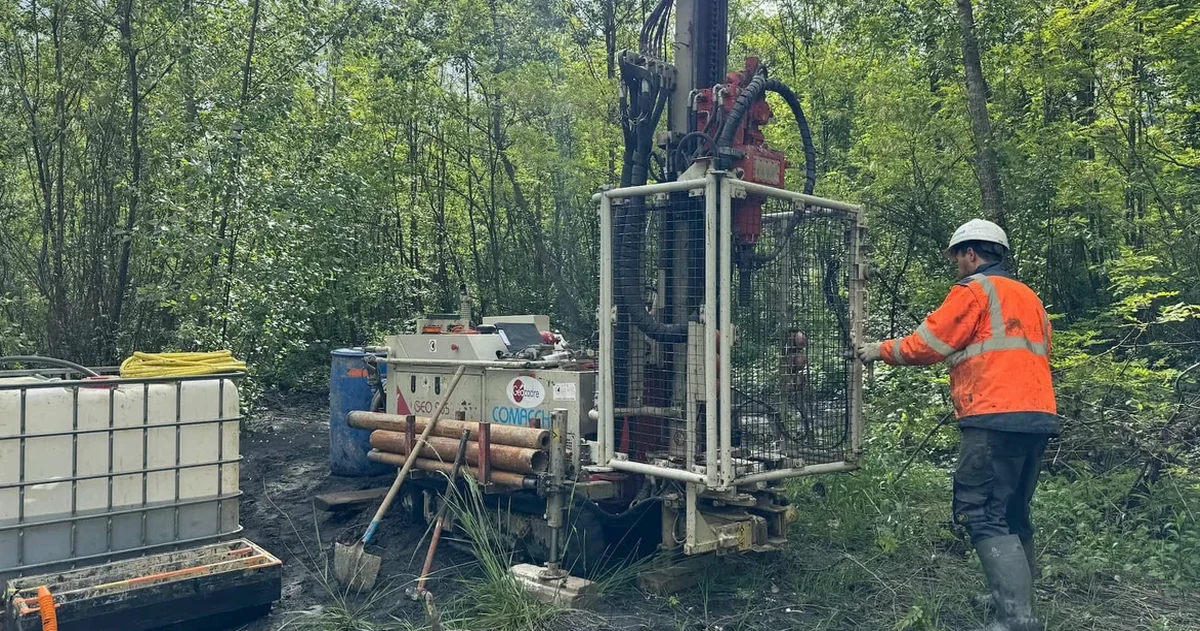
Methodology applied in Granby Quebec
Risks and considerations in Granby Quebec
The geotechnical contrast between the old town sector near the Yamaska and the newer developments on the drumlin slopes is stark. In the river plain, borings frequently encounter 8 to 15 meters of soft, sensitive clay that loses more than 70 percent of its undisturbed strength when remolded—a condition that makes trench collapse and bearing failure real hazards during construction. Up on the till, the risk shifts to obstruction: boulders up to half a meter in diameter that complicate pile driving and can mislead a driller into thinking refusal has been reached prematurely. A CPT investigation bridges the gap by providing a continuous resistance profile that distinguishes a boulder from true bedrock, but the real value lies in the laboratory-derived parameters that allow the geotechnical engineer to calculate settlement and bearing capacity with enough precision to avoid both overdesign and underdesign. In Granby, ignoring the clay sensitivity has led to documented cases of foundation distress within the first three freeze-thaw cycles, particularly where underslab drainage was omitted.
Our services
The soil mechanics study comprises several interconnected field and laboratory components, each chosen according to the specific subsurface conditions encountered in the Eastern Townships.
Geotechnical Borehole Program
Rotary drilling with SPT sampling at 1.5-meter intervals, groundwater monitoring well installation, and Shelby tube retrieval in soft clay layers for undisturbed laboratory testing.
Advanced Strength Testing
CU triaxial, unconfined compression, and direct shear tests on representative samples to establish the Mohr-Coulomb failure envelope used in bearing capacity and slope stability analysis.
Compaction and Fill Evaluation
Standard Proctor tests and field density verification using nuclear gauge or sand cone methods, ensuring engineered fill meets the 95 percent modified Proctor specification common in Quebec municipal works.
Seismic Site Classification
MASW and downhole seismic surveys to measure Vs30, enabling assignment of NBCC site class (C, D, or E) which directly impacts the seismic design forces for the structure.
Quick answers
What does a soil mechanics study in Granby include?
A typical investigation for Granby includes a borehole program with SPT sampling, laboratory classification tests (grain size, Atterberg limits), strength tests such as unconfined compression or CU triaxial, and a geotechnical report with bearing capacity, settlement estimates, and foundation recommendations. If the site is near the Yamaska River or on the Champlain clay plain, the study will address sensitivity and potential long-term settlement under load.
How much does a soil mechanics study cost for a residential lot in Granby?
Why is the NBCC site class important for my Granby project?
The NBCC 2020 uses the average shear-wave velocity in the upper 30 meters (Vs30) to assign a site class from A to E. In Granby, soft clay sites often fall into class D or E, which amplifies the design seismic forces compared to a rock site. Knowing the site class early prevents costly structural redesign and ensures the building meets the seismic provisions of the Quebec Construction Code.