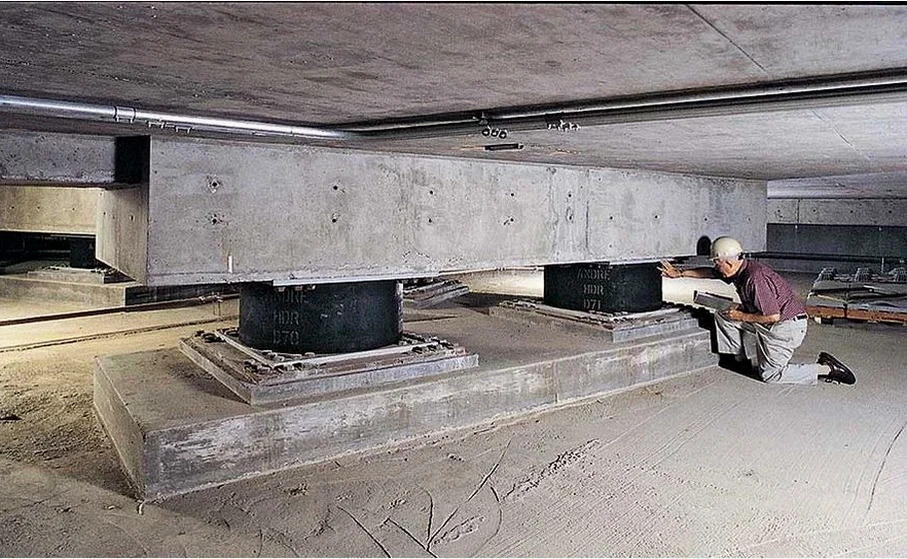
In Granby, the combination of glacial till deposits and the city’s position within the moderate seismicity zone of the Eastern Townships creates a unique set of challenges for structural engineers. We routinely see design teams grappling with how to protect post-disaster buildings, healthcare facilities, and industrial infrastructure when the bedrock is deep and the overburden is a complex mix of dense till and soft lacustrine pockets. A conventional fixed-base approach often forces oversized structural members and still leaves fragility at the non-structural level. Base isolation seismic design shifts the strategy entirely: rather than resisting ground motion through strength, the structure is decoupled from the shaking through a flexible interface at its foundation. For projects in the Yamaska plain, where we have conducted MASW profiling to classify site response, the reduction in spectral acceleration demands achievable with lead-rubber or friction pendulum isolators can be the difference between a facility that is repairable after an event and one that is not.
Decoupling a building from the ground in Granby means accounting for Champlain Sea clay amplification and designing isolators that remain stable through a Quebec winter freeze-thaw cycle.
Methodology applied in Granby Quebec
Risks and considerations in Granby Quebec
NBCC 2020 Article 4.1.8.12 requires that all structures with irregular configuration or post-disaster importance be analyzed using dynamic methods; for base-isolated buildings in Granby, non-linear time history analysis is not optional, it is the minimum standard. The primary risk we encounter in this region is the mischaracterization of the isolation gap. Under maximum considered earthquake (MCE) shaking, the isolator displacement can exceed 400 mm on soft soil sites, and if the moat wall or utility connections are detailed without sufficient clearance, pounding can occur that effectively bypasses the isolation system. A secondary concern is the vertical component of near-field shaking; while Granby is not immediately adjacent to a major fault, the Charlevoix Seismic Zone has generated events that produced significant vertical accelerations at distance. Isolators must be checked for uplift and buckling under combined maximum horizontal displacement and vertical excitation. We also enforce a rigorous peer review protocol because the Quebec professional engineering framework holds the engineer of record responsible for demonstrating that the isolation system meets the collapse prevention objective under MCE.
Our services
Our base isolation engineering package for Granby projects encompasses the complete design and testing workflow, spanning feasibility studies to prototype testing oversight and construction-phase inspection.
Site-Specific Seismic Hazard Analysis
Probabilistic and deterministic hazard assessment for the Granby coordinates, including soil amplification factors derived from deep borehole shear wave velocity profiles.
Isolator Selection and Non-Linear Modeling
Comparative analysis of LRB, HDRB, and FPS systems using ETABS and SAP2000 with non-linear link elements calibrated to manufacturer test data.
Prototype and Production Testing Oversight
Witnessing of full-scale isolator testing per ISO 22762 at accredited laboratories, including low-temperature cycling and aging protocols relevant to Quebec winters.
Construction-Phase Gap Detailing and Inspection
Detailed design of isolation interfaces, moat covers, and flexible utility connections; field inspection to verify that isolation plane is free of unintended restraints.
Quick answers
What is the typical cost range for base isolation seismic design for a mid-rise building in Granby?
Does NBCC 2020 mandate base isolation for any building category in Granby?
NBCC 2020 does not explicitly mandate base isolation for any occupancy; it mandates performance objectives. For post-disaster buildings and high-importance structures, the code requires that the building remain functional after the design earthquake. Base isolation is often the most cost-effective way to demonstrate compliance with this objective, particularly on the soft soil sites common in the Yamaska plain.
How do you verify that the isolation gap is sufficient during a major earthquake?
We run non-linear time history analyses under MCE-level ground motions to determine the maximum isolator displacement, then apply a factor of safety of 1.5 to the moat wall clearance. The analysis uses at least seven ground motion pairs scaled to the site-specific spectrum, and we check the 90th percentile displacement. All utility crossings are detailed with flexible loops that can accommodate the full displacement plus an additional 25% margin for torsional effects.
What testing is required for elastomeric isolators before installation in Quebec?
Per ISO 22762 and CSA S6, every production isolator undergoes a compression stiffness test and a shear stiffness test at design displacement. Prototype testing is more extensive and includes full-scale dynamic cycling, low-temperature conditioning at -30°C, aging under ozone exposure, and scragging recovery verification. We oversee these tests at the manufacturer’s facility and review all test reports before the bearings are shipped to the Granby site.