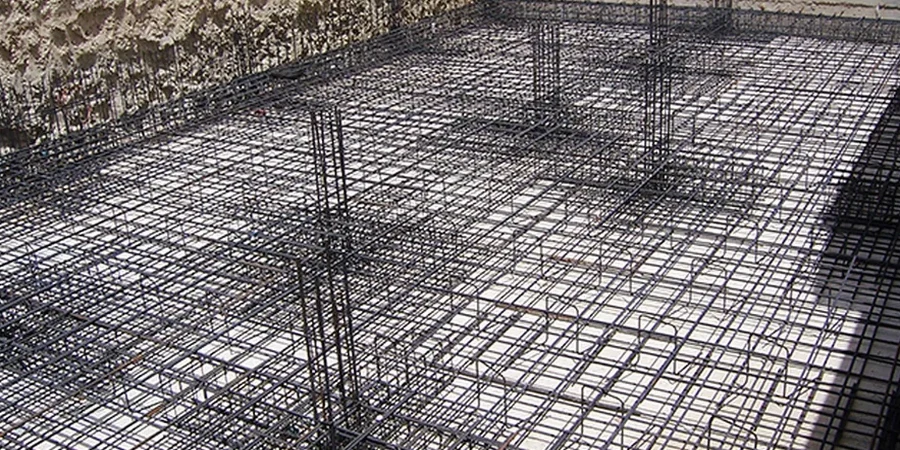
A warehouse expansion off Rue Cowie last fall hit unexpected silty clay at 2 meters. The initial footing design called for a bearing pressure that the soil simply couldn't deliver. We ran the consolidation tests, checked the strength parameters, and the structural engineer switched to a stiffened raft. Problem solved before a single yard of concrete was poured. Granby sits on soils that vary from glacial till to lacustrine clay, and the frost depth here reaches 1.5 meters. A mat foundation distributes building loads across a wider footprint, reducing differential settlement in these conditions. Our lab handles the full testing program ASTM D1194 and D2487 classification so the design team gets reliable numbers for modulus of subgrade reaction. For deeper investigation on sites near the Yamaska River, we often pair this work with spt drilling to confirm refusal depth.
A properly designed mat foundation turns variable Granby soils into a predictable structural platform.
Methodology applied in Granby Quebec
Key aspects we evaluate:
- Modulus of subgrade reaction for Winkler spring models
- Long-term consolidation settlement under sustained load
- Frost protection requirements per NBCC Division B
- Soil-structure interaction for irregular column grids
Risks and considerations in Granby Quebec
We have seen contractors in the Eastern Townships assume a uniform bearing stratum when the site actually has lenses of soft silt. They pour a uniform thickness slab and six months later the corners crack. The differential settlement problem starts in the geotechnical report, or the lack of one. A mat foundation without proper site-specific parameters is just a thick slab guessing at the loads. Granby's frost action adds another layer of risk. Inadequate edge insulation or insufficient depth lets ice lenses form beneath the mat, lifting and cracking the perimeter. Our testing program catches these conditions early. We run moisture content profiles, Atterberg limits, and consolidation curves so the design accounts for both short-term construction loads and the long-term reality of seasonal ground movement.
Our services
Our Granby foundation design support covers the full data pipeline from site investigation to final parameter delivery. Each service feeds directly into the structural engineer's model.
Soil Bearing Capacity Testing
Plate load tests or SPT correlations to establish the allowable bearing pressure for mat design under NBCC limits.
Consolidation and Settlement Analysis
One-dimensional consolidation testing to predict total and differential settlement over the design life of the structure.
Frost Protection Design Parameters
Soil thermal properties and moisture data to support insulation requirements and edge detailing per Granby's 1.5 m frost depth.
Subgrade Modulus Determination
Calculation of the modulus of subgrade reaction for use in finite element or Winkler spring foundation models.
Quick answers
What soil conditions in Granby make a raft foundation necessary?
Much of Granby sits on glaciolacustrine clays and silts with moderate to high compressibility. When the bearing stratum is variable or the water table is high, a raft spreads the load and reduces differential settlement. We quantify these conditions through lab testing so the design decision is based on measured data rather than assumptions.
How much does a raft foundation design study cost for a Granby project?
How long does the lab testing take before the engineer can start the raft design?
Standard classification and strength tests take 5 to 7 business days. Consolidation tests, which are critical for settlement predictions, require 10 to 14 days because we must allow time for each load increment to stabilize. We schedule the testing sequence to deliver preliminary numbers early and final parameters as soon as the consolidation curves are complete.