Granby's development pushed outward from the Yamaska River after the 1850s, placing more infrastructure on the glaciolacustrine clays and tills that blanket the Eastern Townships. The river's old channels left behind lenses of silty sand and gravel that complicate groundwater control during excavation. When a new foundation or retaining structure reaches these deposits, guessing the permeability coefficient is a fast track to dewatering failures. We run field permeability tests using the Lefranc method for soil and the Lugeon procedure for rock, giving contractors and design engineers measured hydraulic conductivity values they can plug directly into seepage models. The work ties frequently into slope stability assessments where pore-water pressure profiles control factor-of-safety calculations on the valley walls.
A Lugeon value below 3 in the slate bedrock near Granby typically means grout curtains can be optimized, but fracture dilation above 10 bars pressure can double apparent permeability.
Methodology applied in Granby Quebec
Risks and considerations in Granby Quebec
The Yamaska River lowlands around Granby carry a shallow water table—often within two meters of grade in spring—and the silt layers within the Champlain Sea sequence are prone to boiling where upward gradients develop during dewatering. Running a Lefranc test solely at the base of a borehole without isolating the screen can yield a blended result that misses perched water or thin sand stringers. For Lugeon testing, the main pitfall is packer bypass: in highly fractured phyllite we have seen water track around the packer and emerge at the collar, producing falsely high Lugeon values if not detected. We use dual-packer setups with downhole pressure transducers to catch this. In Granby's industrial park expansions, ignoring fracture-flow anisotropy has led to dry excavations on one side of a cut and continuous seepage on the other—a costly sequencing problem.
Our services
Lefranc and Lugeon programs are performed as independent investigations or as components of integrated geotechnical drilling operations. Typical applications within the Granby area include:
Lefranc Testing in Overburden
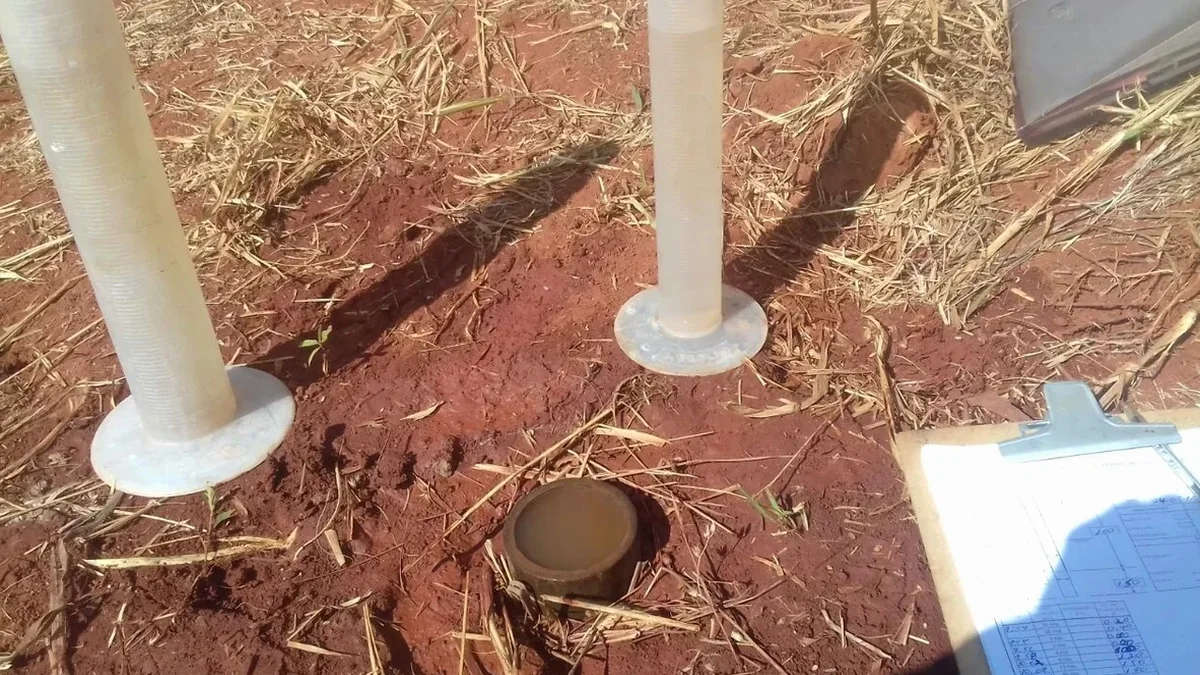
Variable-head falling/rising tests in silt, sand, and clay using a slotted standpipe with packer isolation. Delivers k values for dewatering design in the Champlain Sea deposits.
Lugeon Testing in Bedrock
Multi-stage packer testing in NQ/HQ boreholes through slate and phyllite. Quantifies fracture permeability for dam abutments, tunnel pre-excavation grouting, and deep foundation drainage.
Grouting Verification Permeability
Pre- and post-grouting Lugeon panels to confirm curtain effectiveness. We test the same intervals before and after injection, comparing Lugeon units to specification targets.
Dewatering Feasibility Assessments
Permeability profiling across a site with multiple Lefranc tests to feed MODFLOW or SEEP/W models. Used for open-cut excavations and permanent underdrain design in Granby's commercial corridors.
Quick answers
What is the difference between a Lefranc test and a Lugeon test?
The Lefranc test measures hydraulic conductivity in soil using a slotted casing or probe with a packer; it is run as a falling- or rising-head test in granular or cohesive deposits. The Lugeon test is performed in rock using a pneumatic packer to isolate a borehole interval, applying water under stepped pressure to evaluate fracture permeability. We use Lefranc in the overburden clays and tills around Granby, and Lugeon in the underlying slate and phyllite bedrock.
When is a Lugeon test required instead of a Lefranc test?
Lugeon testing is required when the project involves rock excavation, dam foundations, grout curtain design, or tunnels where fracture flow dominates. If the bedrock surface is within the zone of influence of the excavation or structure—common in Granby where rock is encountered at 5 to 15 meters depth—we specify Lugeon intervals below the soil-rock interface. Lefranc testing covers the overburden portion of the profile.
How much does a field permeability testing program cost in Granby?
How many Lugeon stages do you run, and why?
We run a five-stage cycle: low, medium, high, medium, low pressure. This sequence detects hysteresis from hydraulic jacking or fracture infilling. If the flow at the final low-pressure stage is higher than the initial one, it indicates permanent fracture dilation—a critical finding for grouting design that a single-stage test would miss entirely.
Can you test permeability in an existing monitoring well?
Yes, with caveats. A monitoring well with a short screen in a uniform formation can yield a usable Lefranc value via slug testing. However, wells with long screens crossing multiple lithologies produce blended results that are unreliable for design. We prefer to test in dedicated boreholes with packer-isolated intervals, especially in Granby where the stratigraphy alternates between clay, silt, and sand over short vertical distances.