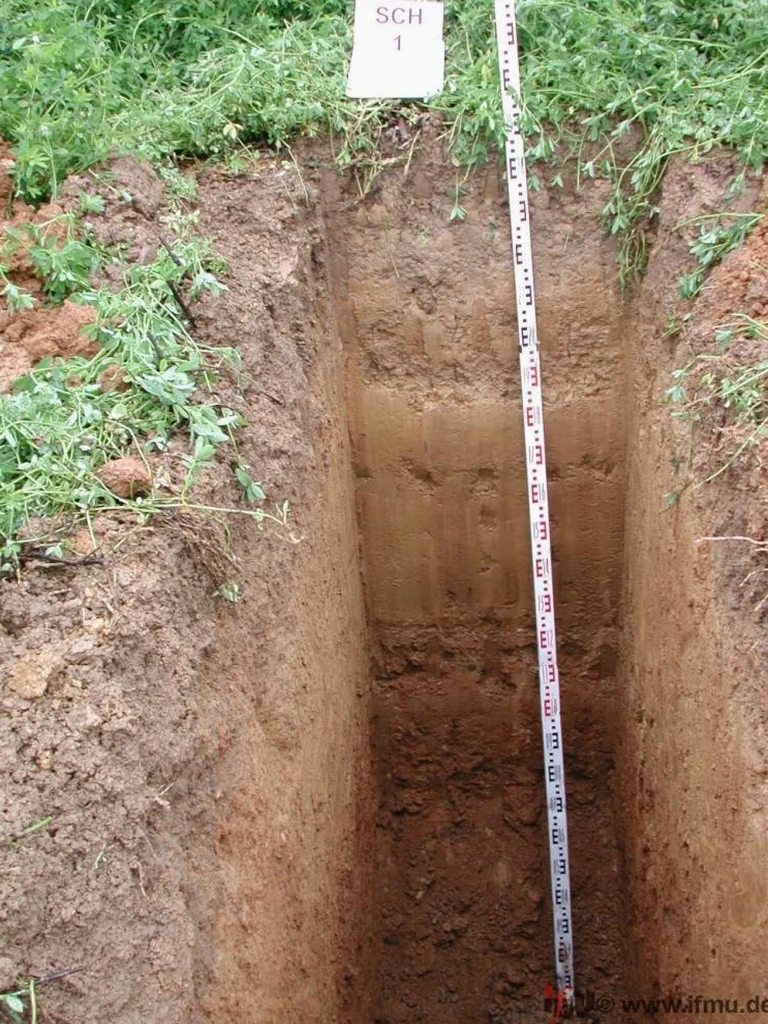
The soil difference between central Granby near the Yamaska River and the new developments pushing into the eastern hillsides is night and day. Downtown, you hit soft alluvial silts and a high water table within a couple of meters. Head east towards the Shefford Mountain foothills and the ground shifts to dense glacial till packed with granite cobbles that'll fight a backhoe every inch of the way. One standard approach doesn't cut it here. An exploratory test pit lets us see these transitions directly in the pit walls, mapping exactly where the bearing stratum changes. For deeper refusal conditions in the compact till, we often pair this visual data with an SPT drilling program to get penetration resistance numbers when the bucket can't advance further. This direct observation is critical for foundation design that accounts for Granby's variable post-glacial geology.
A single well-logged test pit can replace dozens of assumptions about Granby's erratic glacial stratigraphy.
Methodology applied in Granby Quebec
Risks and considerations in Granby Quebec
A practical reality we see repeatedly in Granby is that many lots in older neighborhoods like the area south of Rue Denison were backfilled decades ago without compaction records. Digging a test pit there often reveals a chaotic mix of brick fragments, ash, and loose sand that you'd never detect with a drill rig alone. Even on undeveloped land, assuming the glacial stratigraphy is uniform is a gamble. A hidden pocket of soft, normally consolidated clay from a former post-glacial pond can exist between dense till layers. If you skip this investigation, you risk designing a footing on a lens that compresses differently than the surrounding soil, leading to angular distortion and cracked superstructure. The cost of the exploratory test pit is negligible compared to the engineering and legal headaches of a differential settlement claim.
Our services
Our exploratory test pit investigations in Granby are structured to provide a complete geotechnical picture, not just a hole in the ground. Each component is tailored to the specific soil conditions we encounter.
Stratigraphic Wall Logging
Detailed layer-by-layer documentation of the exposed pit walls using USCS, capturing soil type, color, moisture, consistency, and the precise depth of each transition.
In-Situ Groundwater Assessment
Observation of water ingress points, measurement of initial seepage rates, and, where schedule allows, monitoring of the stabilized groundwater level after a 24-hour period.
Disturbed and Block Sampling
Collection of representative bulk samples for laboratory classification, and hand-carved block samples from cohesive layers for strength testing without the disturbance of a split spoon.
Bearing Capacity Verification
Correlation of the logged soil profile with the NBCC 2015 presumptive bearing values table, providing an immediate on-site reality check for proposed footing elevations and dimensions.
Quick answers
What is the typical cost of an exploratory test pit investigation in Granby?
How deep can you dig a test pit in Granby's glacial soils?
With a 20-tonne excavator, we routinely reach between 4 and 5 meters. However, in the dense St-François till that covers much of the eastern slopes, large granite boulders can cause refusal earlier. We'll log the refusal depth and can recommend a supplementary CPT or SPT investigation if deeper data is needed.
Do you need a test pit if I already have an SPT drilling report?
They serve different purposes. An SPT report gives you a log and blow counts from a narrow borehole. A test pit exposes a continuous wall of soil, letting us see thin sand seams, organic layers, or construction debris that a split spoon can easily miss. For complex jobs, the combination of both methods gives the most reliable ground model.