Granby sits at an elevation of roughly 140 meters, a city of over 69,000 people where the legacy of the post-glacial Champlain Sea defines everything underground. That marine incursion left behind thick sequences of sensitive clay and silt — the kind of soil that loses strength when disturbed. Pile foundation design here is not a generic exercise. It requires understanding exactly where the competent till or bedrock lies beneath those compressible layers, and how the pile will behave under the combined demands of a harsh freeze-thaw cycle and the seismic loads prescribed by the NBCC. A CPT test across a site near the Yamaska River, for example, can reveal the subtle transition from soft clay to dense glacial material that governs pile length and capacity.
In Granby's Champlain Sea clays, pile capacity is governed more by setup time and pore pressure dissipation than by the hammer energy on the day of driving.
Methodology applied in Granby Quebec
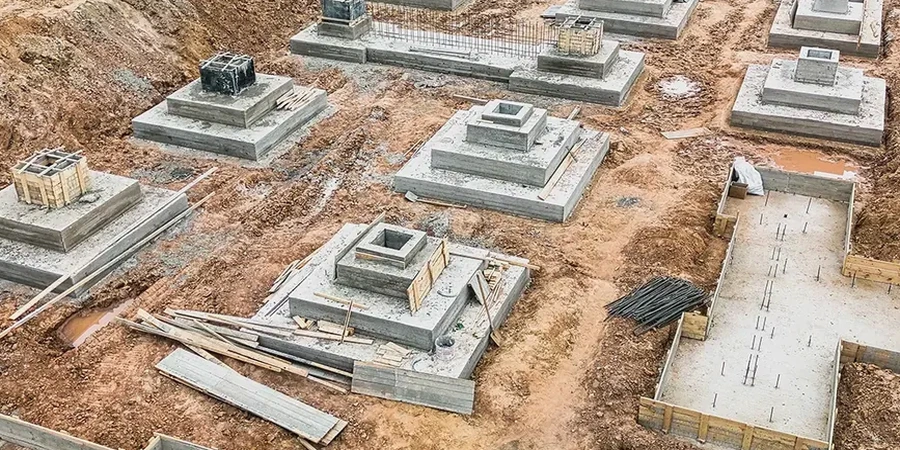
For projects in the industrial parks east of Highway 139, where fill thickness varies, we often recommend instrumented preliminary piles to confirm the driveability and the actual capacity before finalizing the production pile design. This approach eliminates the guesswork that leads to costly change orders or, worse, foundation underperformance.
Risks and considerations in Granby Quebec
Granby's urban expansion from a small mill town into a diversified manufacturing and logistics hub has pushed development onto marginal land once considered unsuitable for heavy structures. The former agricultural tracts and low-lying areas near the tributaries of the Yamaska often conceal compressible clay layers exceeding 15 meters in thickness. Designing pile foundations in these areas without accounting for the long-term consolidation of the surrounding soil can result in downdrag forces that overload the piles and cause differential settlement.
Seismic demand adds another layer of complexity. Granby lies within the Western Quebec Seismic Zone, and the soft clay profiles can amplify ground motion significantly. A pile foundation designed only for vertical loads may fail in bending under lateral spreading or kinematic interaction during shaking. Our risk assessment explicitly models these scenarios, examining both the inertial forces from the structure and the deformation demands imposed by the moving ground.
Our services
Our pile foundation design service in Granby covers the full engineering lifecycle — from planning the subsurface investigation through to construction-phase support. Each scope is tailored to the project's risk profile and the specific soil conditions encountered.
Geotechnical Characterization for Pile Design
Designing the field and lab program to extract the parameters that actually control pile behavior: undrained shear strength profiles, preconsolidation pressure, soil stiffness, and cyclic degradation properties for seismic analysis.
Pile Type Selection and Axial/Lateral Analysis
Evaluating driven vs. drilled alternatives considering site access, noise restrictions, and soil profile. Computing ultimate and service-level capacities, settlement under load, and lateral deflection under wind and seismic forces.
Construction Support and Load Testing
Reviewing pile driving logs, conducting dynamic testing with CAPWAP analysis, and overseeing static load tests. We confirm that production piles meet the design criteria and adjust the driving criteria based on real-time field data.
Frequently asked questions
What depth of pile is typically required in Granby Quebec?
There is no standard depth — it depends entirely on the depth to competent bearing material beneath the Champlain Sea deposits at your specific site. In some areas near the Yamaska River, bedrock or dense glacial till may be reached at 8 to 12 meters. In other locations with thicker clay sequences, piles may extend beyond 25 meters. We determine the target depth through cone penetration testing and boreholes before any pile design begins.
How do you account for frost action in pile design?
Frost heave can exert substantial uplift forces on piles, particularly in the silty soils common around Granby. We specify a minimum pile cap embedment of 1.4 meters below finished grade and, where necessary, design the upper portion of the pile with a bond breaker or protective sleeve to prevent the adfreeze bond from transmitting heave forces to the structure.
What is the typical cost range for a pile foundation design in Granby?
For a comprehensive design package — including geotechnical parameter review, pile type selection, axial and lateral analysis, and construction specifications — project fees generally range between CA$2,600 and CA$8,680. The final cost depends on the number of pile types evaluated, the complexity of the seismic analysis, and the extent of construction-phase load testing support required.
Do you handle both driven and drilled pile designs?
Yes. We design driven steel H-piles and pipe piles, as well as drilled shafts and continuous flight auger piles. The choice depends on the soil profile, access constraints, and the structural demands. For example, drilled shafts may be preferred near existing buildings where vibration from pile driving is a concern, while driven piles often provide a more economical solution for large warehouses on open sites.