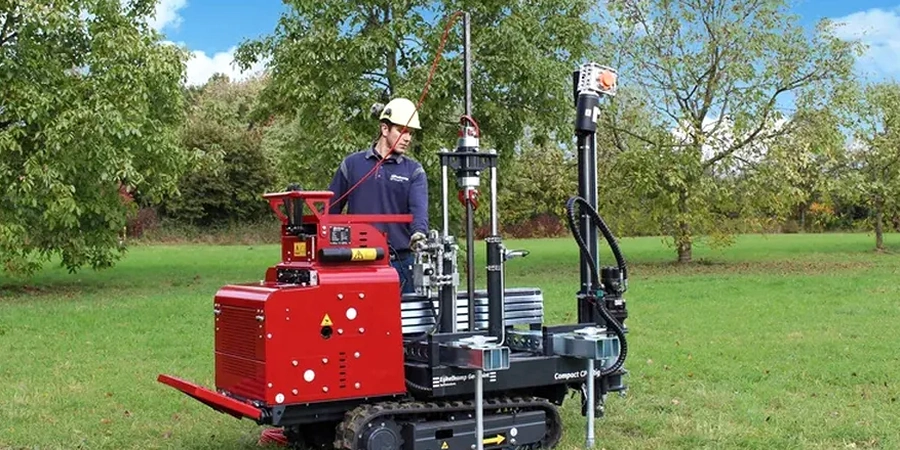
On a recent project near the Yamaska River, we watched a standard SPT rig struggle to capture the transition between the desiccated crust and the underlying sensitive clay—a scenario we encounter constantly around Granby Quebec. The CPT (Cone Penetration Test) eliminates that blind spot by recording sleeve friction, pore pressure, and tip resistance every two centimetres, which means you get a virtually uninterrupted log of the Champlain Sea sediments that define the local stratigraphy. Because Granby sits on a mix of glacial till, marine clay, and occasional sand lenses, the continuous profile allows us to pick out thin drainage layers that a conventional boring might miss entirely. We run the test with a 20-tonne push truck equipped with a 15 cm² cone and a u2 piezo element, following ASTM D5778-21 from setup to dissipation. When the client needs shear-wave velocity for an NBCC site class, we pair the CPT with a seismic downhole survey and cross-check the results against the SCPTu data to refine the Vs30 estimate without mobilizing a separate spread.
A single CPT sounding in Granby clay replaces three boreholes for stratigraphic profiling—and it gives you pore-pressure data that no spoon sample can capture.
Methodology applied in Granby Quebec
Demonstration video
Risks and considerations in Granby Quebec
The contrast between the east and west sides of Granby Quebec illustrates what happens when CPT data is missing. On the east side, closer to the Appalachians, glacial till with abundant cobbles and boulders dominates the upper 8 metres—refusal can occur suddenly, and a contractor who budgets for easy pushing will face delays. On the west side, near the Yamaska floodplain, the soil column is deep, soft, and highly sensitive; remoulded strength can drop by a factor of 4, which means a pushed cone tip that loses saturation gives misleading pore-pressure readings and an overly optimistic bearing estimate. Without a dissipation curve from a properly saturated filter element, you risk designing a footing that settles differentially on a thin clay seam that the CPT would have flagged. In Granby, a single unscheduled refusal adds a half-day of standby time, and in sensitive clay, a missed thin sand layer can turn a straightforward pad footing into a post-construction levelling problem that costs far more than the test itself.
Our services
We deliver CPT soundings across Granby Quebec with the support of a mobile laboratory that handles cone calibration, filter saturation, and data reduction on site. Each project includes a digital log and a summary of interpreted parameters ready for your foundation designer.
Standard CPTu with Pore-Pressure Dissipation
A full piezocone profile recording qc, fs, and u2, plus dissipation tests at depths specified by the design engineer. We report corrected cone resistance, friction ratio, SBTn classification, and t50 consolidation estimates—all processed the same day the truck demobilizes.
Seismic CPT Sounding
A cone equipped with a triaxial geophone at 1-metre intervals to measure downhole shear-wave velocity. We correlate the Vs profile with the SCPTu data to produce an NBCC-compliant site class without a separate geophysical crew, which keeps the overall investigation budget under control.
Frequently asked questions
How deep can you push a CPT in Granby Quebec before refusal?
In the soft Champlain Sea silts and clays west of the city centre, we routinely reach 28 to 32 metres with a 20-tonne push truck. In the glacial till that crops out east of Highway 139, refusal often occurs between 7 and 12 metres; we pre-drill through the bouldery cap when the project requires deeper data.
What does a CPT test cost for a typical Granby residential lot?
For a single-family lot with one sounding to 15 metres, the cost ranges from CA$230 to CA$380 depending on mobilization distance and the number of dissipation tests requested. Commercial sites with multiple soundings are quoted per mobilisation day.
Can the CPT replace boreholes for a foundation design?
The CPT provides a continuous stratigraphic profile and high-quality geotechnical parameters, but it does not recover physical samples. We recommend combining at least one borehole with SPT sampling for index testing—grain-size analysis and Atterberg limits in particular—while using the CPT soundings to fill in the gaps between boreholes and to measure pore-pressure response.
How do you handle the cold weather during winter CPT work in Granby?
We saturate the piezocone filter with glycerin instead of water, which prevents freezing and maintains fast pore-pressure response even when the ground is frozen in the upper 40 centimetres. The push truck carries an enclosed calibration station so the cone temperature stays stable throughout the day.