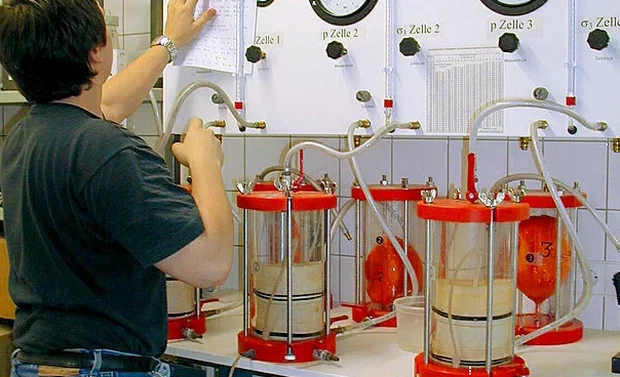
The NBCC and ASTM D1883 frame every pavement project in Granby, but local compliance hinges on one thing: subgrade strength data that reflects actual site conditions. At 45.3885 N, the Haute-Yamaska region deals with freeze-thaw cycles and variable glacial till deposits that make presumptive bearing values unreliable. Our laboratory runs soaked and unsoaked CBR tests on remolded samples compacted to specified density and moisture content, generating load-penetration curves that feed directly into AASHTO 1993 pavement design or the mechanistic-empirical MEPDG framework. We correlate results with on-site sand cone density measurements to verify that field compaction matches the laboratory reference, and we cross-check fines content with grain size analysis when the material is borderline between silt and clean sand. Every specimen is extruded, trimmed, and soaked under a surcharge weight that simulates the design pavement structure.
A 4-day soaked CBR test reveals what a dry strength check never will: the real bearing capacity of a subgrade after spring thaw.
Methodology applied in Granby Quebec
Demonstration video
Risks and considerations in Granby Quebec
Granby sits at roughly 200 m elevation in the Eastern Townships, where the last significant seismic event affecting the region was the 1988 Saguenay earthquake (M 5.9), felt across southern Quebec. While seismic shaking is moderate, the real risk to pavements here is cyclic freeze-thaw: the city experiences over 100 freeze-thaw cycles per winter, according to Environment Canada climate normals. A subgrade that tests at CBR 8% in summer can lose half its strength during the spring thaw when trapped moisture cannot drain. The laboratory soaked CBR test replicates this worst-case scenario by saturating the specimen for four days under a surcharge load. Skipping the soaked condition and designing with the unsoaked value leads to premature rutting, alligator cracking, and base course failure within two to three seasons. We see this pattern repeatedly on secondary roads and commercial parking lots where design cuts were made without verified soaked CBR data.
Our services
The laboratory CBR result is only one link in the pavement design chain. We provide the complementary testing needed to build a complete geomechanical profile.
Standard Proctor Compaction (ASTM D698)
Determines the optimum moisture content and maximum dry density used to prepare CBR specimens at the target compaction level.
Swell Potential and Moisture Sensitivity
Monitors volume change during the 96-hour soak, critical for evaluating frost-susceptible silts common in the Haute-Yamaska plain.
Pavement Thickness Design Correlation
We provide CBR input values formatted for AASHTO 1993 design charts or MEPDG Level 2 inputs, including seasonal adjustment factors.
Frequently asked questions
What is the difference between soaked and unsoaked CBR, and which one should I use for a parking lot in Granby?
Unsoaked CBR is tested at the compaction moisture content without water immersion. Soaked CBR submerges the specimen for 96 hours under a surcharge weight before testing. For Granby's climate, with over 100 freeze-thaw cycles annually, the soaked value is mandatory. It represents the subgrade during spring thaw when the pavement is weakest. Designing with the unsoaked value typically underestimates the required base thickness by 50 to 100 mm, leading to early rutting.
How much does a laboratory CBR test cost?
A single-point laboratory CBR test, including compaction curve preparation, specimen molding, and soaked or unsoaked penetration, ranges from CA$170 to CA$300 depending on the number of compaction points and whether swell monitoring is required. Multi-point CBR programs for linear infrastructure projects are quoted per sample volume.
What sample mass do I need to bring to the laboratory for a CBR test?
For one CBR point with the corresponding Proctor compaction curve, bring approximately 45 to 50 kg of disturbed material in sealed bags. The Proctor test alone requires about 20 kg, and each CBR mold uses roughly 5 to 6 kg per compaction point. If the material contains particles larger than 19 mm, additional mass is needed for scalping replacement.
How long does it take to get CBR results?
An unsoaked CBR can be reported in 2 to 3 working days. A soaked CBR requires 4 days of immersion plus the time for compaction and testing, so the standard turnaround is 7 to 8 working days. Expedited schedules are possible if the compaction curve is already available, reducing the timeline to the soaking period plus one testing day.